
Pulse Market Review
-Monday, February 19, 2001
This analysis featured in the February 19, 2001 issue of the HGCA's MI Prospect, Volume 3, Number 16
With the exceptionally wet autumn and perhaps an extra 350,000 hectares to be sown this spring, many farmers are reviewing their remaining seeding options. Pulses, principally peas and beans, appear to be prime candidates, when and if it stops raining for long enough for seed bed preparation.
Market prospects for pulses seem relatively solid and on the cost side, with very limited outlay on fertilizers needed, they an appear attractive option
.
Key Points
- Prices driven mainly by soyameal
- Pulse area could rise
- Other issues, including GM and BSE, could ipact EU prices
Background
Although peas and beans, the two most important pulse crops grown in the UK, have a number of important niche markets, most production is for the livestock protein feed. Also as niche market prices are usually premiums to feed pea and bean prices, prospects in the protein feed market are reviewed in this article.
Global production of peas and beans currently amounts to about 12 and 18 million tonnes, respectively. A major part of this output is grown in the third world where these crops are an important source of protein in human diets.
Certainly less than half world pea and bean production is grown for livestock feed and is dwarfed by supplies of oilseed meals of about 180 million tonnes, of which about 115 million tonnes is soyabean meal.
continue Source: HGCA
continued
UK pea and bean prices are generally between 55 and 65 percent of soya meal prices. This reflects their protein content of 22 to 28 percent, rather more than half of soya meal at 44 to 48 percent. Peas and beans prices are normally within a few pounds of each other. Beans have a somewhat higher protein content but are sometimes more difficult to feed which limits their value often offsetting the former advantage.
Recent Market Developments
Peas and beans have traded in a relatively wide £25 per tonne range over the last 12 months.
Prices generally declined by about £15 per tonne over the summer months to about £72 per tonne ex farm in August as prospects for the US soya bean crop improved and harvest pressures developed.
After harvest prices improved, and particularly so in late November when the European BSE crisis emerged(Chart 2). A six-month Europe-wide ban on the feeding of meat and bone meal was imposed by the European Commission in early December. Europe produces and consumes annually about 3.0 and 2.5 million tonnes, respectively, of meat and bone meal so the elimination of this feed source was significant.
continue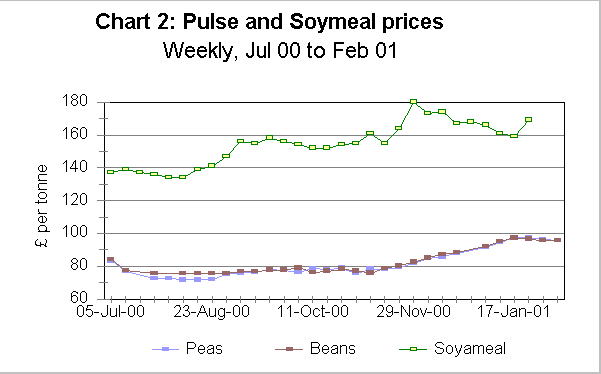 Source: Farmers Weekly , HGCA
continued
In January ex farm prices have held firm in a-mid £90's per tonne range. At the same time soya meal prices have softened by almost £20 per tonne from their late November peak as prospects for south American soya bean crops improved, US acreage expectation rose and general economic conditions particularly in the US slowed.
Market Prospects.
As pulse prices are at the moment towards the top end of their range relative to soya meal, some weakening relative to meal is likely in the short term. This should not be of undue concern in the longer term context of post harvest prices which will be driven by soya meal price prospect.
Farmers every where are facing some rather unpalatable cropping options. Because of the high fertilizer prices and/or shortages, US soyabean acreage is expected to increase this spring at the expense of maize. The US soyabean acreage and crop development will have a major bearing on soyabean and soyameal prices for most of 2001.
These factors seem, however, to be in the market. Even so current new crop prices at £95 per tonne, delivered, for both peas and beans about £10 per tonne higher than those prevailing in 1998, 1999 or 2000.
Two further items, BSE and the GM (genetic modification) issue, are worthy of brief mention. While they are both some what difficult to quantify, they are widely perceived separately, or together, to have future implications.
As long as consumers concernr remains over GM crops and ingredients, premiums are likely to develop for ingredients such as the pulses that can be labelled as "non-GM".
Several UK supermarket chains have recently announced plans to sell meat produced from "non-GM" feed. This is probably the first time that consumers will be faced with a clear GM/ non-GM choice at the retail counter. Pulses, as an undisputed non-GM feed protein source, would benefit from consumer preference for non-GM foods. For the moment, however, there seems little evidence of any "non-GM" premium, even if it is being used liberally in a marketing context.
While there is no direct link between the BSE crisis and the genetic engineering issue, it is a popular perception that the former sensitized public opinion to the later. Hence the recent concern over the widespread discovery of BSE in Europe may add to GM concerns.
Finally, it is necessary to consider the implications of a substantial increase in UK pulse acreage. If spring is relatively early, a substantial portion of unseeded winter cereal acreage could be diverted to pulses and result in a substantial increase in English pea and bean acreage which together are usually less than 200,000 hectares(Table 1).
Table 1: Area, Yield and Production for England1997 1998 1999 2000 % change 2000/1999 * Field Beans Area, thousand hectares 98 110 111 122 9.7 Yield, tonnes per hectare 3.8 3.4 3.5 3.6 2.9 Production, thousand tonnes 374 375 386 439 13.8 Peas for Harvesting Dry Area, thousand hectares 96 100 87 82 -6.1 Yield, tonnes per hectare 3.8 3.2 4.0 3.7 -7.5 Production, thousand tonnes 364 317 346 305 -11.9Source: MAFF
And as it already seems that seeding conditions will be less than ideal over the target February time slot for seeding beans, peas which benefit from later seeding are likely to be a more popular choice.
Consumption prospects for an increased supply are favourable. The use of pulses in compound feeds could be increased very substantially, subject to competitive pricing against soya meal. In the past, continuity of supply has been regarded as an impediment to higher levels of incorporation of pulses in compounded livestock feed with the industry normally reliant on imports through the summer months.
Help from the pulse Processors and Growers Research Organisation in collecting information for this articles is gratefully acknowledged.
David Walker 01603 705153
top of page